Writers Make Choices
Story Design in the Age of AI
You’re a six-year-old child on the beach (Noice!). It is a clear and still morning. You carry a plastic sand pail and toy trowel. You sit down near the edge of the calm water where the sand waits, beaten, soaked, pliable: This raw material is, you know, the perfect consistency for sandcastle construction. You get to work.
You drive the trowel into the canvas of sand and work forward, furrowing a trench. You don’t know exactly what you’re doing but you know that you’ve begun. Pleasantly, a little stolid water rills into the channel. Ah! You’re digging a moat. You draw the trowel through the wet sand in a broad arc. But no, let’s not make a circle, maybe a different shape… Stars. Stars are interesting. You crank your line into a star shape in the sand.
As you work the trowel forward through the sand, new berms rise on either side of the tip of the plastic blade. Perfect. You can pinch those new wet plow ridges into walls to protect your castle. Now you have a perimeter. Let’s dig in the center now and initiate work on the castle proper.
You are digging, you are working, you are playing. You are building and designing in parallel. This is good stuff.
Now, imagine that your little sibling trots up to you. He’s a few years younger and often annoying but he is your brother so you tolerate him pretty well.
He sees what you are doing, he carries his own trowel, so he—predictably—finds his own spot a little too close to yours and apes you. As you watch him struggle, you realize he doesn’t really have a strong grasp on what a proper sandcastle should look like. You try to take over but he insists on doing it himself. “Just tell me what to do,” he says.
So you do. You stand at a remove and verbally guide the kid. As he digs, he churns up new ridges and you tell him how he should make good use of those. After a long and not unpleasant while, you both collide with the limits of your patience and declare the second castle complete, or at least, “close enough.”
You stand back and observe the two sandcastles.
One you simultaneously designed and built. The other, you guided and designed. You were project manager, consultant, coach, and maybe even co-architect.
Which was the more satisfying to build? Of which do you feel more ownership?
The world still has two new sandcastles, and that’s a good thing, but what exactly just happened? And what was your role? What was your collaborator's?
The New York Times Magazine recently published “AI Might take Your Job. Here are 22 New Ones It Could Give You” by Robert Capps. It’s thoughtful and measured. Stimulating stuff for those of us who do not want to be AI Doomers but also cannot claim an embarrassment of optimism (for reasons such as our species).
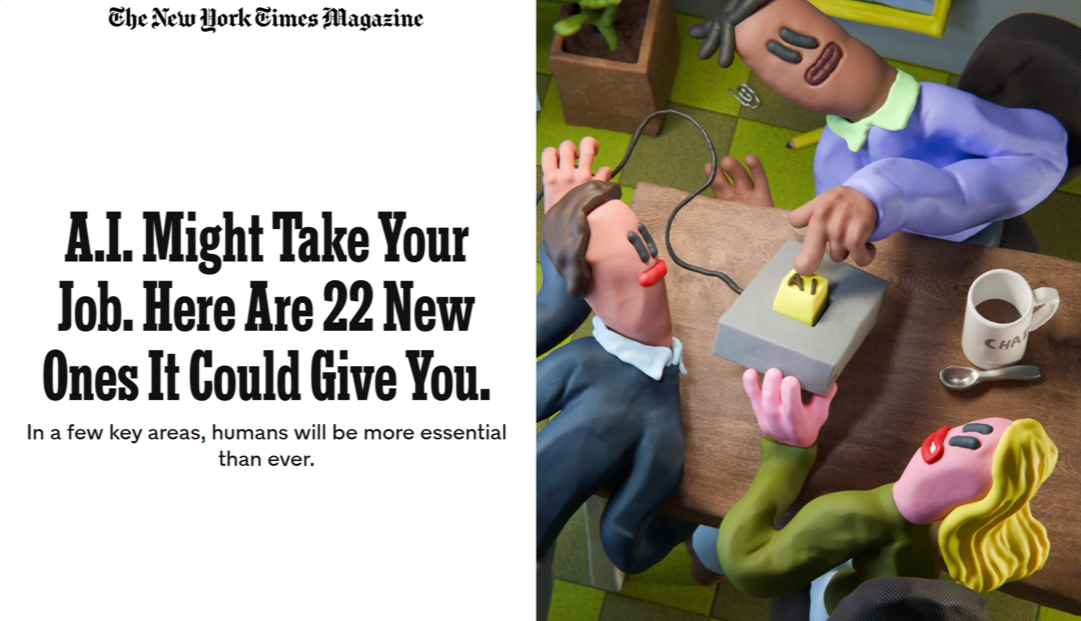
The essay includes input from Aneesh Raman, LinkedIn's Chief Officer of Economic Opportunity, and others, who (against the cresting narrative of a white-collar apocalypse) offer informed projections of the type of human work that may currently be emerging.
Some of the professional titles seen and foreseen: AI Auditors, AI Translators, AI Integrators, AI Personality Director, Article Designer, Story Designer.
The speculative roles fall into three categories: Trust, Integration and Taste. The category most interesting to me—and, I suspect, to Capps as well—is Taste.
Capps transcribes the 60 Minutes Anderson Cooper/Rick Rubin interview clip you may have seen in which Rubin, frankly and clearly, says, “The confidence I have in my taste and the ability to express what I feel has proven helpful for artists.”

Capps writes: “When creative options are nearly limitless, people with the ability to make bold, stylish choices will be in demand. And this will be true not just for creative industries such as writing, filmmaking and advertising but for business of all kinds. Knowing what you want—and having a sense of what will resonate with customers—will be the core human role in developing products and systems.”
“Bold, stylish choices” is the key there.
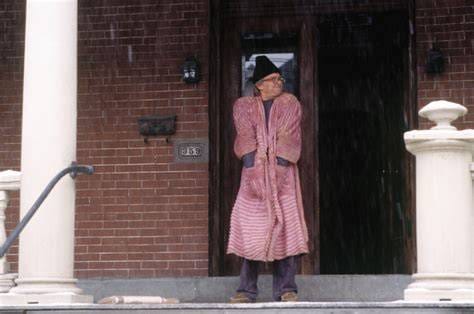
The Michael Chabon novel Wonder Boys, adapted to an excellent (I’m not wrong) Michael Douglas-led film, sets its drama within a university Creative Writing department.
Most every character is a writer, and they consistently remind one another: “Writers make choices.”

There are consequences to failing to make choices. And there are consequences to making low-quality choices. In creative work, choice is no small thing. It’s actually the thing.
What drives such choice? Often taste.
But what is taste? Often judgement.
A religious studies professor of mine once asked our class, “What am I being paid for? I’m being paid for my judgement.” I knew instantly what he meant—and that this was not good news for me.
His experience, earned expertise, and the self-evident quality of his thinking awarded him the authority to exercise his judgement against our thinking and the quality of our submitted work.
There is really no second guessing his assessment. There may not be some secret argument or sacred template any given student essay must match; but there is the pretty much unassailable quality of his judgement that student work seeks to satisfy.
By sitting in that class, by paying tuition, by bothering at all, we were enacting the implicit contract between Teacher and Student: One has not only more knowledge, but better judgement, than the other.
If you can judge, if you can exercise taste, then you can make a series of high-quality decisions that will lead to high-quality creative work.
Writers make choices.
Capp: “There are some titles we already have, like product designer, that will simply grow to encompass a whole lot more. In the future, product designers will have a much greater ability to own products, from top to bottom. The role will be not just about the big picture but also about all the choices that bring that big picture to life.
And there are other design qualifiers that will likely come into vogue. I might, for example, not be a writer but an article designer. Story designer might become a more popular title in film and TV.”
Article Design. Story Design. Are these synonymous with Narrative Design, which we see in game development?
Let’s start with an article—or an essay. I am writing this essay right now. I would say I am designing it as I write it. Which is to say that I am, in parallel, structuring the draft as I draft it.
But what does that mean?
I am:
- Writing (thinking and converting that thought into ordered language and committing it to paper; shepherding thoughts into the world or a space such that it can be physically communicated to another) and structuring that writing into blocks (paragraphs)...
- Sequencing those blocks such that more expansive and logically sound meaning may be massed. (And, also, I am simultaneously...)
- Evaluating the writing and the organization of that writing, as I write it.
This is the act of outlaying an argument. But it’s also the act of exploring, building and testing my argument to see if it stands and if I even believe it—concurrent to the process of revealing it to myself.
Now, what if I design it instead? What does that entail?
Capp: “‘Designer’ may not end up being the preferred nomenclature, but it usefully signifies the shift. More and more people will be tasked with making creative and taste decisions, steering the A.I. where they want it to go.”
Where they want it to go. Let’s start at the end. We have a vision, a goal, a desired outcome. But we don’t have the guts of the experience yet (I won’t say "content").
Let’s say we’re designing an article or an essay, rather than writing one. If we spend ten or twenty minutes scrupulously outlining the structure, requirements and objective of this essay, and then spend another half hour writing and finetuning and inputting prompts, shuttling the outputs between different LLMs, and stacking and revising, re-stacking and re-revising, the outputs to our satisfaction, we know we would (very soon) gift ourselves an at least acceptable final output.
What’s the difference between those two acts? What’s the difference between writing and designing a story, article or essay?
Writing works from the bottom up (structure is enacted). And design the top down (structure is enforced).
I’m not arguing that one is superior to the other (Writing is superior.), but I’ll say this: Writing is more useful to the artist, and design is more useful to the agent (human or not).
Why is this?
Because the agent is more efficient.
Writing requires that the writer (artist or not) marshal elements, style, formulas and structure.
"Story Design"—as envisioned—requires that the designer (agentic or not) marshal formula and structure (elements and style are optional or can be deferred with placeholders).
It is not the nature of Art to be efficient. It is the nature of Art to be revelatory.
So, either way we’d get there (I hope) but a difference between the two modes is how close we are to the material.
Designing a story is a lighter lift and (offloading the work of marshaling the elements) puts us at a remove.
We can address this in the editing phase and apply more humanity and more experience—but we’re working our way in from the outside.
Writing is the inverse. We’re starting within the experience; fulfilling and expanding it with our own thinking and beautifying it with our choices concurrently.
Now, if you've made it this far into my essay, I love you. I also acknowledge that you may at this point fairly think, "Okay, bro. Your thesis (buried far too deeply within this piece) seems to be:
‘In the age of AI, the work of creating—writing, building, storytelling—diverges into two paths: the writer who enacts structure through process, and the designer who imposes structure as process.
Both are valid but not the same. And how we define these acts will shape what kind of work we do, how much ownership we feel, and what amount of pride or alienation we allow to be imprinted upon us afterward.’
[Skeptical Reader:] Cool. So what exactly do you propose we do about it?”
Writing and "story design" (as I'm defining it here) are not mutually exclusive. Lines blur. Forms of writing hang along a long and liquid spectrum. Doesn't a playwright write within a structure? Must not a designer solve unforeseen problems creatively and on the fly?
And, for frack's sake, how about non-literary artforms? Talk to me about structure in Cave Art, bro. We could generate a pretty undisciplined conversation instantly.
It's all Art with a capital A for a reason.
Writing (as it's existed since Mesopotamians first scratched Cuneiform into clay five thousand years ago right up through November 29, 2022) could be trusted to be the output of one or many human minds.
Authors and editors were distinct but at least human.
Writing—very generally—produced its own reviewable and self-evident chain of thought. ("How did you come to this point on page five, Gene?" "Well, Bob, if you read pages one through four, you might find the smart answer to your dumb question. For further reading, check out this precise Works Cited page.")
Should Story Designer (the role as Capps defines it, and the act as I do) become a next stage in the evolution of professional writing, I hope we demand and expect disclosure of Gen AI collaboration, radical transparency: including the transcript of prompts and queries.
Imagine outputs (posts, articles, books, videos, full paracosms) that are expected to include a path to inviolable metadata that details and documents the exchange of work between human and agent, such that audiences can know where to place their trust, skepticism, hearts and minds. Not a watermark. But the complete record.
If your sales rep relies heavily on her company's in-house agent to author a proposal, you may not care, but you can know.
If your groom offloads the writing of his wedding vows to Grok, you should know it. And care you should.
Next, if we take Story Design seriously, we won’t just ask “What is it and why and how do we do it?”, we’ll ask “How do we get better at it?”
For this answer, we would do well to return to Rick Rubin’s point: “The confidence I have in my taste and the ability to express what I feel has proven helpful for artists.”
Taste. Intuition. An unapologetically sharp eye. The ability to articulate the requirements, contours and biases of your earned high-quality taste. Are they skills? Well, they're certainly assets, and they are not push-button.
[Skeptical Reader:] A tall order. So how do you get that?
By doing the work, over and over again, endlessly, without any expectation other than gruelingly slow, invisible improvement.
[Skeptical Reader:] What?
By reading and writing a lot. Repetitive work, long hours and years spent deep in the guts of unassisted creation; line editing develops and refines tastes by forcing decisions. Writers make choices. And the more you do it, the better you’ll get.
I’m no Luddite. I am developing my own position on AI in the Arts.
But, at the same time, Sarah and John Connor taught me right.
I am openly and deeply skeptical of any creative and/or commercial work developed hand-in-claw with this novel “Digital species”, as Mustafa Suleyman calls it.
Writing improves thinking. Better thinkers will make better decisions. Even and especially when they function as “Story Designers.”
So write. Right now.
Let's revisit our sandcastles.
The first sandcastle was all you: a singular individual, and you have the sand under your fingernails to prove it. You are its author. Anyone can ask about any feature or flaw, and you can answer. You, after all, made every choice.
Your singular focus, your engaged imagination—your agon, let’s call it—was active and burning at the very tip of the blade of your mind.
You are dirty and you are proud. And you know, with crystal clarity, who made that sandcastle.
The second is still a sandcastle. And while our fingerprints are not directly on it, some of our recommendations are visible. The act was different. We “co-designed” it. And we are somewhat less accountable for every flaw, and also somewhat less responsible for every strength.
We sacrificed some agency and ownership; and shared the work and the responsibility. Is it better? It is different.
Now, shift your eyes from the sandcastle to the surf, and the sea. There. See those hulking ships on the horizon? Are they commercial fishing boats? Cargo ships? Aircraft Carriers?
It matters not. What matters is that they are complex and sophisticated, even proud, vehicles, built for a task, and they are–at this moment–enacting their mission, getting things done for the benefit of businesses, customers, individuals, groups or nations.
They are ships at sea.
And ships, we all know, have one captain for a reason.
Thank you for reading this issue of Thrill State. Now that I have resolved the tension between human creativity and generative AI, I will next reverse the global energy crisis.