Wrestle Forever
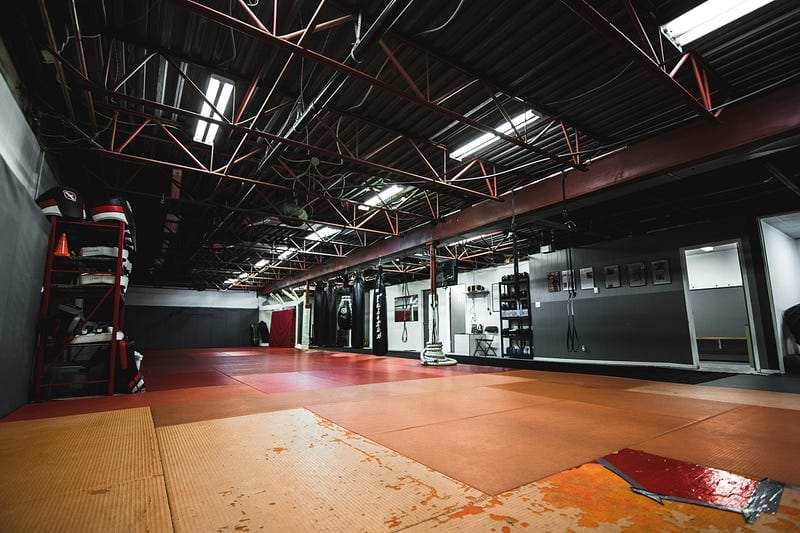
My wrestling coaches used to shout “Many hands make light work!” at the begining and end of every practice. We, the young wrestlers, would gather as one to drag the enormous heavy sheets of wrestling mats across the gym floors.
Many hands make light work. A phrase I hadn’t heard or thought of in twenty years. Until I heard it shouted again the other day, by the same coaches, as I watched my son help drag those same heavy mats across that same gym floor.
Wrestling was my sport in junior high and high school. I was never any good, but I enjoyed it. I didn’t take to team sports, never had much patience for anything too organized or structured, and I had a pretty persistent bad attitude through most of those years.
Wrestling was the sport that met a certain need in me.
Recently, I took my six-year-old son to his first day of a summer wrestling camp at the same high school gym I all but lived in one million years ago. A few of the same coaches are still there: older, heavier, grayer, but there they are, still going through the same motions and shouting the same instructions.
As a “rising first grader” (odd term), my son is in youngest age bracket at this camp. On this particular first day of the session, the gym burst with kids (including no small number of girls, I noticed) his own level up through junior high ages. Counting us parents, there are probably a hundred people in the space. I knew walking in might be a little intimidating, but if it was, my kid didn’t show it.
He separated from me at the bleachers and found his way to the center of the floor, where all the students performed their warm-up together. Let’s say eighty kids, ages 6 through 14, jogging in a loose loop, performing bear crawls, grapevines, and high-knee runs together. My son was instantly swallowed in a circular storm of kids twice his height. I lost sight of him frequently. When I found him again, he was always smiling.
The class was then divided into age groups — relief — and a pair of coaches led the first and second graders through a series of wrestling games for the next hour and change.
On the bleachers, I was well-positioned to observe the couple of kids who refused to venture out on to the mat. I didn’t stare, but I saw and heard the trepidatious reaction of those small boys who wanted no part of what they were seeing for the first time. And I understood it.
These children were being instructed — not asked — to put their hands on one another, to apply force, to grapple, to work under strange and stressful conditions. Art class, it is not. One of the coaches came over and tried to assuage the kids. No success.
I won’t make this about what my son did or did not do during his first class. I’m not looking for him to evidence preternatural skill or even instant affinity for the sport. We’re there in that gym for many reasons, but the significant one is simple exposure to something different.
He and I wrestle at home, we always have. He’s a physical kid and not afraid to throw down — in good or less-than-good nature — with his sister, his uncle, his dad. We’re not going to this camp to stir up some animal in him. But we are going, among other reasons, to get out of the comfort zone for a sustained period of time.
We’re going there to be exposed to something with an edge for a couple of weeks.
Why?
Because I believe — and I don’t think this is a profound statement — that exposure to difficult (or at least uncomfortable) situations for some length of time matters. It’s mattered in my life. I believe that it has mattered in the lives of my heroes.
My literary hero Charles McCarry was an actual CIA officer operating under cover overseas during the Cold War.
My entrepreneurial hero Jocko Willink is a retired Navy SEAL who led soldiers in combat in Iraq.
I am no spy; I am no soldier. But I believe that neither of these men would have produced their trenchant bodies of work (that so deeply speak to me and others) in the second halves of their lives, had they not passed through their own long fires in the first.
Many hands may make light work. And many years of practice make better doers.
I don’t know what transformative life challenges await any of my kids. I don’t know what challenges yet await me. I do know that I’ve benefitted from long periods of entrapment (maybe the right word, maybe not) in such challenging and uncomfortable conditions. I can think of examples personal, professional, and physical.
And it wasn’t just that exposure, it was the duration of the exposure, that advanced (however minimally) my character, my capabilities, or both.
I’m a better public speaker today than I was five years ago. I still get nerves, I still speak too quickly, and I still make fumbles; but I suck at it materially less than I used to, because I’ve simply had to do a healthy bit of it, frequently, for a while now.
I’m grateful for every speaking experience I’ve had, and I’m even grateful for the ones that hurt so bad I still think about them regularly years later.
Exposure to such speaking opportunities has helped. Longer speeches, in bigger rooms, with more eyes on me for longer minutes has helped. The improvements, over the years, have been palpable.
In my case, it’s not simply the exposure, but the duration of the exposure that’s helped.
Weightlifters will tell you that time under tension builds muscle. This applies — you guessed it — outside of the gym as well.
Angela Duckworth’s research (her book GRIT is outstanding) proves that perseverance — grit — counts for more than raw talent in achieving long-term success. Like weightlifters under tension, students, artists and athletes improve and expand their capabilities through consistent effort over time.
How much time? Years, decades and lifetimes.
People with a moderate history of adversity report better mental health and well-being outcomes than those with either no adversity or a high history of adversity. Research suggests that facing some adversity can foster resilience, leading to lower distress and higher life satisfaction. Moderate adversity helps people develop toughness and control, such that they’re better able to handle future stressors (and don’t we all have those?).
True mastery and expert performance are the result of sustained, deliberate practice over a long period of time. Individual differences in performance, even among elite groups, are closely related to the amount and quality of deliberate practice.
Other research finds that innate talent is less important than the accumulated hours of focused, effortful practice designed to improve specific skills. Mastery typically requires thousands of hours of such practice, often extending over at least a decade.
I’ve spent an enormous portion of my life sitting alone and writing (humblebrag). It’s often very, very challenging for me. Stirring up and ordering thoughts on a blank page is frequently — in my experience — grueling work that leaves you battered and with just so little to show.
I can’t prove it, but I know that my craft has improved over the past twenty-five years because of the time spent head down, bent under the pressure of intention, galvanized by only the thinnest layer of skill and diligence.
When I first started wrestling as a kid, it was fun. When it got competitive, less so. I started to stress and I probably self-sabotaged a lot. I wasn’t comfortable around the older, better, more aggressive, more successful athletes with whom I spent just so much time. But, for reasons that probably had more to do with perceived external pressure rather than my own drive, I stuck with it for a period much longer than I would have expected of myself.
Now, twenty years later, I don’t think about the meets or the matches, or the few wins or many losses. I think about the practice. I think about the time spent in the gym, in the locker room, on the bus, in the car, back in the gym after school or on Saturday mornings. That was where its value imprinted on me, in some way. Advanced me, in some way.
It was the hours — every day — working in an environment that demanded more of me, that added a touch of experience and accomplishment to my life.
If my son rejects wrestling, I won’t care. He’ll find a challenge that answers his need. What I do hope for him is that he finds and exercises the will to commit to that challenge — to persist within its arena, regardless of success or failure — for the long run, for a meaningful duration, for a period of years or decades or a lifetime; and that his father is cool and smart enough to support him in the right ways at the right times.